
Needless to say, the Suel were not pleased; so, it was not long before they and the Bakluni came to blows. What began as small raids and minor skirmished escalated into widespread hostilities. War had swept the West. And, if that were not enough, Tharizdun had slipped back into Oerth through ever widening cracks.
The Peoples of the West were on the move. And the Flanaess would never be the same.
Invoked Devastation and Rain of Colourless Fire Strike

The Great War had reached its height. Thousands had perished, and thousands would perish still. Each revelled in their atrocities, citing moral and racial superiority, eager to cleanse the land of the filth that tainted it.
In the Suel Empire proper, the Suel mages gather their magical energies and cast the Invoked Devastation. No Bakluni cities survive this blast of magical energy. But Bakluni mages gather at Tovag Baragu, using the arcane powers of the Binders, and drawing upon the energies of their holiest site, withstand these energies and counterstrike with the Rain of Colorless Fire. The remains of this expenditure of energy are now called the Dry Steppes, and the Sea of Dust. The holders of all Four Binders are utterly destroyed but the binders themselves are not. [OJ11] 224 OR/ 5094 SD/1729 FT
When the Invoked Devastation came upon the Baklunish, their own magi brought down the Rain of Colorless Fire in a last terrible curse, and this so affected the Suloise Empire as to cause it to become the Sea of Dust. [Folio]
The Suloise lands were inundated by a nearly invisible fiery rain which killed all creatures it struck, burned all living things, ignited the landscape with colorless flame, and burned the very hills into ash. [Folio] 224_OR/ 5094 SD/1729 FT
Cup and Talisman of AI’Akbar:

This pair of holy relics were given by the gods of the Paynims to their most exalted high priest […] in the days following the Invoked Devastation. It was lost to demihuman raiders and was last rumored to be somewhere in the Southeastern portion of the Bandit Kingdoms. [DMG 1e]
And thus the world was sundered, its rending felt from sea to sea, and all the peoples to the east looked to the west and thought that those great magi and their Binders had brought doom to them all. The skies lit up as never before, and, for a time, there was no night, so bright was the firmament to the west. But the end did not come. The tremors persisted, then faded, the eerie red glow slaked and withdrew to the horizon, and finally below the towering mountains there until it too faded from sight, if not from memory.
How could it? The tattered remnant of the Suel fled their homeland as the devastation rained down upon them. They crossed the Hellfurnaces into the Sheldomar Valley where the Oeridian tribe of Keogh took pity on them and welcomed them, and together they began to build what would become a vast kingdom, settling swiftly and (so they say) peacefully under the guidance of their seers. They defeated the remnants of Vecna’s Occluded Empire and drove the Flan to the fringes of the Valley.
That’s the story, anyway. But, Mordenkainen wrote otherwise in On The Rise of Magecraft and Modernity. The Suel were not peaceful, he wrote. They’d never been peaceful. Their Houses fought for control of one another even as they established themselves, and even drove their own minor Houses from the Valley altogether. Indeed, the Suel were striking pacts with those Ur-Flan who still held sway over Vecna’s Lands, even as they were seen to fight against them.
Some remained aloof. Or maybe they were just biding their time. Their seers stood apart from such petty struggles, and joined together as “Those Who Must Not Speak,” to serve all the Houses, guiding them. It’s been suggested that the Order was actually founded to keep certain aspects of Suel Magic from the Oeridians, who, as yet, still lacked great sorcerers of their own. However the circumstances of their formation, “Those Who Must Not Speak” were tasked with restraining the spread of magic, and seeking out and stopping those who would unleash such death and destruction as had already been unleashed on them. In time they came to be known as the Silent Ones.
Queen Ehlissa’s Marvelous Nightingale:

The origin of this artifact is unknown, although the Mage Mordenkainen is reported to have asserted that the Nightingale was made by Xagy and the goddess of volcanic activity, Joramy, some 17 centuries ago. Queen Ehlissa bent all to her will with the enchantments of the device, and throughout her reign […] several Suel [were] banished to margins of the Flanaess. [DMG 1e]
-366 CY Not all Flan kingdoms were as formidable. The coming of the Aerdy tribes incited panic among the citizens of Veralos, for it was only a city of artisans, highly skilled in creating the wonders of ages past, magical tablets and statuary and ensorcelled jewelry, even weaponry that was coveted by all the lords of Sulm, Itar, Ahlissa, and Nuria; but alas, they were not skilled in those arms. Legends say that an Ur-Flan prophet came to that ancient citadel of Veralos, and reaping their fear, he persuaded them to seek the succor of an ancient and sinister force. 278 OR/ 5150 SD/ 1785 FT
The Oeridians swept the Flan aside with ease. They were fierce. They were relentless. And they’d come prepared. They had learned from their former masters, and remembered those lessons well. They studied those Suel books and artifacts they’d taken with them. They tinkered. They failed at first to comprehend what they studied, and then one day they didn’t. Great magics were revealed to them. And the art of artifice. Leuk-O was particularly adept at such studies. And he was a wonderful tinkerer. He recreated those marvelous machines the Suel had used against them with such deadly effect. And he used them well.
Mighty Servant of Leuk-O:
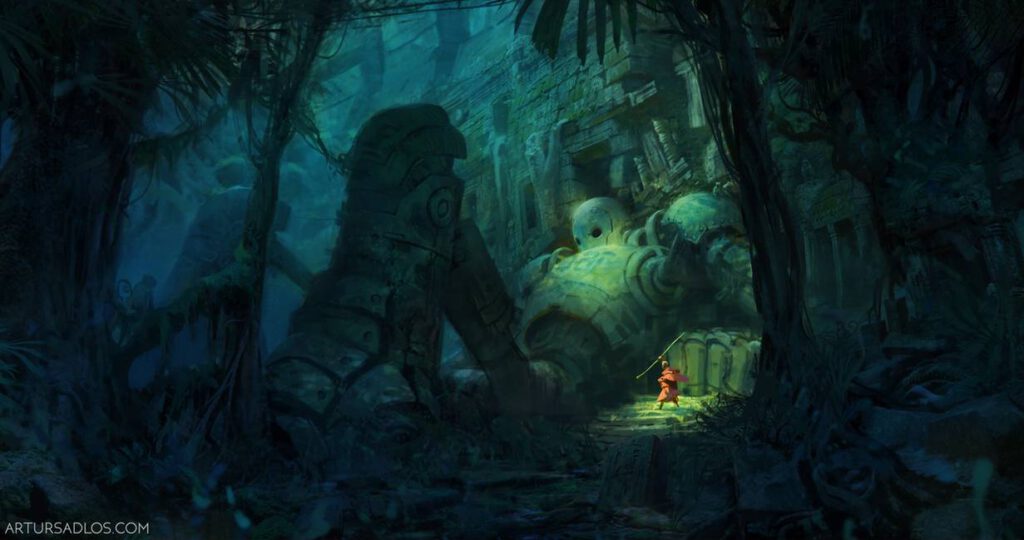
Those who are most knowledgeable regarding ancient artifacts believe that this device is of the same manufacture as the Machine of Lum. The Mighty Servant of the famous General Leuk-O is a towering automaton of crystal, unknown metals, and strange fibrous material. It is over 9′ tall, 6’ deep, and some 4′ wide. Inside is a compartment suitable for holding 2 man-sized creatures, and there is space for 4-5others to sit outside. If the possessor knows the proper command phrases, he or she can use the Mighty Servant as a transportation mode, magical attack device, or fighting machine.
The Mighty Servant regenerates [damage done to it]. [It is reputedly immune to magic.] Acid, cold, fire, heat, vacuum, and water have no effect on the device. [DMG 1e]
Science of Temporal Waves, by Leuk-0 [Dragon Magazine 82]
Machine of Lum the Mad:
Perhaps this strange device was built by gods long forgotten and survived the eons since their passing, for it is incredibly ancient and of workmanship unlike anything known today. The Machine was used by Baron Lum to build an empire, but what has since become of this ponderous mechanism none can say. Legends report that it has 60 levers, 40 dials, and 20 switches (but only about one-half still function). Singly or in combination, these controls will generate all sorts of powers and effects. [DMG 1e]
The Minds of The Unknown, by Baron Lum [D82]
Baron Lum wielded Druniarzth against the Ur-Flan sorcerers until he lost it in the Battle if the Bonewood. Druniarzth is a fell blade, an artifact that exists only to serve Tharizdun and free him from his endless slumber. Lum spent his remaining years trying to recover the sword, the search eventually driving him mad.
-217 CY Founding of the Kingdom of Aerdy.
-194 CY Exploration of the Solonor Ocean begins.
-171 CY The Battle of Chokestone.
Chokestone
This place, and the lands around it, are deserted, not farmed by anyone. The site is that of a great battle between Aerdi men and a small Flan tribe in -171 CY. The Oeridians were easily triumphant, and an excessively brutal general ordered the torture and sacrifice of all surrendering Flan folk in thanks to Erythnul. The following day, the Aerdi army woke from its camp to find that the land for several square miles around had been stripped of vegetation. Only slate-like stone remained. As they trod upon the stone, it cracked as if it were brittle paper, releasing clouds of oily, choking smoke. Less than a third of the army managed to march away from the accursed area, and those who survived suffered lung infections and disease which brought their lives to very premature ends. From time to time since this slaughter, a huge black smoky serpentine shape has been spotted prowling the lands around Chokestone, slaying any who dare approach the land where the Flan were slaughtered. Astrologer-sages can predict this wandering; it occurs around once every 17 years, with the “snake” manifesting for […] days. At other times, mages will sometimes try to obtain some of the stone for use in making dust of sneezing and choking, but they invariably send servants to obtain it rather than risking entry themselves. [Ivid]
-107 CY Ur-Flan insurgents attempted to assassinate the King of Aerdy by summoning a “winged horror.” It was their last fruitless gasp at freedom.
So ended the Flan kingdoms.
So began the Aerdian Great Kingdom.
But what of the Houses of Pursuit? What befell them is as much legend and myth as it is truth.
Stories tell of a barbarian empire created by the warriors of Vatun, the “Great God of the North.” The empire, if it existed at all, lasted only for the lifetime of the first fasstal of the Suelii. Some say Vatun was betrayed by a companion deity, but others blame a rival Oeridian god (Telchur) and his clerics; a few even say that the barbarians proved unworthy, being unable to sustain a mighty god’s presence. Regardless, as recorded history dawned in the north, the barbarians’ empire was only a tale of old. [LGG]
Legend has it that should the Five Blades of Curusk be united, Vatun would be freed from his imprisonment and work his revenge against Telchur and the Oerids.
The Fruztii settled in the lands north of the Timberway and west if the Spikey forests where the climate tended towards a more temperate temperament. They farmed their fertile lands; they harvested the bounty of Grendep Bay; they even mined the eastern Griffs; but they also raided the southern coasts with abandon, for those people were weak, and Vatun taught them to do so, and punished those tribes that did not, sending quakes and high seas and fierce winds until they set sail south once again.
The Schnai settled the land between the Corusk Mountains and the wide Grendep Bay, with only the Spikey Forest separating them with the Fruztii. Despite their identical climes, the landscape of the Schnai is more rugged than the Fruztii’s, though not so rough as the Cruski’s. The same could be said of the people, who are more factious than the Fruztii, but more united than the Cruski. It was these differences that inevitably brought their kin under their dominion.
They may not have always been the most powerful of the Suel barbarians, but they never come under the rule of either of their cousin states. Perhaps this is due to the superior seamanship of these barbarians, for they have never been attacked by land. [LGG]
The Cruski settled further east upon Rhizia, the Thellonrian Peninsula, than any of their kin. Theirs is the coldest and most severe of the Suel barbarian kingdoms. Fiercely independent, they hunted and fished and whaled from their seaside towns and their mountain steadings. And like all of their kin, they built longships, for it was and is their way to raid south, and prey upon those plying their trade at sea.
The Cruski themselves are a people of pure Suel race, speaking the Cold Tongue as their native language. Though they have always been the least numerous of the Suel barbarians, their royal lineage is the oldest. The king of Cruski holds the title “Fasstal of all the Suelii,” indicating his preeminence among the nobles of the Suel race and giving him the right to pronounce judgment on any of them. Politically, this has little real importance, for he has no power to enforce his judgments. However, it is said by some that the god Vatun granted this authority to the fasstal of the Suelii; if Vatun awoke, the full authority of the office would return to the fasstal, and a new barbarian empire would emerge under his leadership. [LGG]
The Barbarians and the Kingdom of Aerdy were destined to clash.
And they did.
But that is another tale.
One must always give credit where credit is due. This History is made possible primarily by the Imaginings of Gary Gygax and his Old Guard, Lenard Lakofka among them. Without Len there would not be such a detailed account of the Suel Migration, or the Pantheon of Suel Gods, for that matter. I cannot at this time give credit to all those others who’d contributed to it over the years, because I myself am still learning it and who wrote it. But I can give thanks to Steven Wilson for his GREYCHRONDEX and to Keith Horsfield for his “Chronological History of Eastern Oerik.”
Special thanks to Jason Zavoda for his compiled index, “Greyhawkania,” an invaluable research tool.
The art:
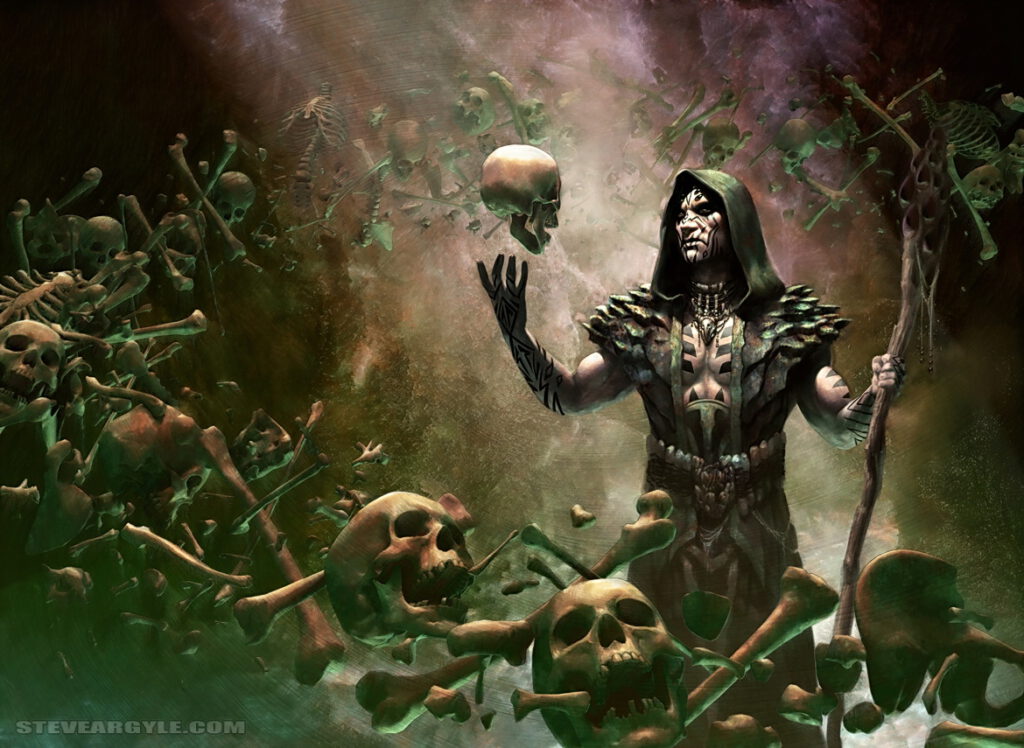
Deathrite-Shaman by steveargyle
War-Relic by artursadlos
Rain of Colourless Fire by Erol Otis, Greyhawk Gold Box, 1983 TSR
Art of Artifacts can be found in the Book of Artifacts, 1993 WotC
Copyright:
All source material presented within this chronology is owned and copyrighted by WotC.
The use of this material is not intended to challenge the rights of WotC.
This document is fan content and presented solely for the personal use of those individuals who game within the Greyhawk Setting.
Sources:
1015 World of Greyhawk Boxed Set, 1983
1043 The City of Greyhawk Boxed Set, 1989 FFF=Feuds, Folks and Factions
1056 Castles Boxed Set, 1990 Hart=Castle Hart Book
1064 From the Ashes Boxed Set, 1992 Atlas=Atlas Book; CB=Campaign Book
1068 Greyhawk Wars Boxed Set, 1991 AB=Adventure Book
2011A Dungeon Masters Guide, 1st Ed., 1977
2023 Greyhawk Adventures Hardback, 1988
2138 Book of Artifacts, 1993
9025 World of Greyhawk Folio, 1981
9027 S2, White Plume Mountain, 1979
9065 WG4, The Gorgotten Temple of Tharizdun, 1982
9253 WG8, Fate of Istus, 1989
9309 WGA4, Vecna Lives, 1990
9386 WGR3, Rary the Traitor, 1992
9398 WGR4, The Marklands, 1993
9399 WGR 5, Iuz the Evil, 1993
9577 The Adventure Begins, 1998 AM=Adventure Maps Book
9578 Player’s Guide to Greyhawk, 1998
11434 Return to White Plume Mountain, 1999
11442 Bastion of Faith, 1999
11662 Die Vecna Die! 2000
11742 Gazetteer, 2000
11743 Living Greyhawk Gazeteer, 2000
Ivid the Undying, 1998
Dragon Magazine
OJ Oerth Journal, produced by the Council of Greyhawk, and appearing on their website
Living Greyhawk Journals
Greychrondex, Wilson, Steven B.

Content originally found on the Greyhawk Musings blog, by David Leonard.


Leave A Comment
You must be logged in to post a comment.