
The Ur-Flan were not idle as Vecna rose to power. They were a greedy and covetous lot, never satisfied to live under the rule of another, so they each sought to carve out their own realms while Vecna threw his forces against the shield of the Elven Kingdoms.
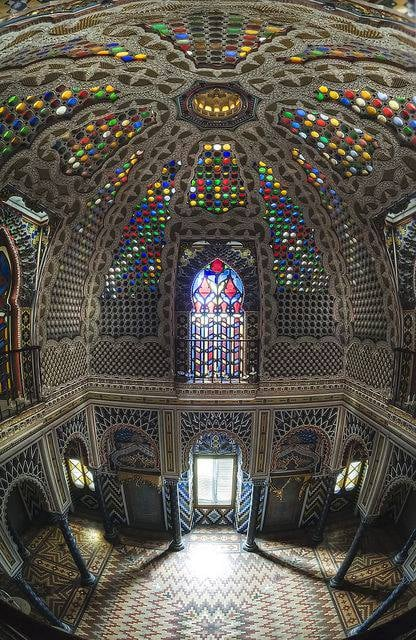
They were not all so. Some sought refuge from the tyranny of their peers. Thus, Tostenhca was born. Those who sought the Wisdom of Pelor fled from their evil brethren into the high and frigid Griff Mountains, where, to their delight, they discovered a green plateau that was of temperate climate in those days. They came upon the Dwarves, who, wary at first for they knew of the Ur-Flan and their war with the Elves, were convinced of the honour and goodness of these people. And it was with the help of the Dwarves that they carved their city from the greenish-black rock of the mountain, and it was a wonder to behold. Ramps, broad avenues, and good roads of such quality were cut through the mountains that they’ve withstood the ravages of time and are still used today by the local dwarves. Their broad avenues were lined with tall statues, backed by the facades and courtyards of the noble estates that were hued into the rock is such a way as to be sky lit by tapestries of coloured glass. Murals adorned their walls. And gardens bloomed and spilled out over the dappled streets in a floral canopy. Enormous cisterns caught the rains and fed their statues and fountains and pumped running water throughout the city.
They flattened terraces for the sake of agriculture around it and in the surrounding valleys as they sought and found others as gentle and fertile.
And what’s more, Pelor shined on them, as their valleys proved rich with gold and jade. Their artisans grew adept in the art of glass, the loom, and the kiln, and as such, they grew rich, and richer still as they traded with Dwarven clans of Ukauric and Ukargic. So rich in fact, that Tostenhca’s central, domed, Temple of Pelor, and the Theign’s pyramid Palace shone brightly with roofs of gold.
They were ever vigil, for they knew that one day Vecna, or one like him would come. And one day, one did come. But they were blind to it when it did come.
It is commonly held that the Flan peoples of eastern Oerth were simple tribesmen before the events that led to the Suel and Oeridian migrations. There remain to be explained certain ruins found in the Griff and Corusk Mountains. The massive stone foundations, straight level roads, and flattened or terraced areas of mountainside seem from the proportions of the rarely preserved door- ways to be intended for creatures of human size, and it seems unlikely that elves or humanoids would have had the inclination to produce such works. What is more, the occasional jade carvings and green ceramic figurines found both at these sites and occasionally in rivers flowing out of the mountains show a people of Flannish features and dress, and there remain in the Duchy of Tenh and among the Coltens stories of a powerful mountain state of Flann- ish race. Perhaps the dwarves of the region know more, but if so, they show the typical reticence of demi-human races concerning prehistoric events. One of the greatest works of this ancient people, whoever they were, is the mountain known in Flan as Tostenhca, but more commonly known by the name the Suel barbarians gave it, Skrellingshald. It is a place which has been discovered many times, and as often lost again from human knowledge. [2023_Greyhawk Adventures]
 |
| Keraptis |
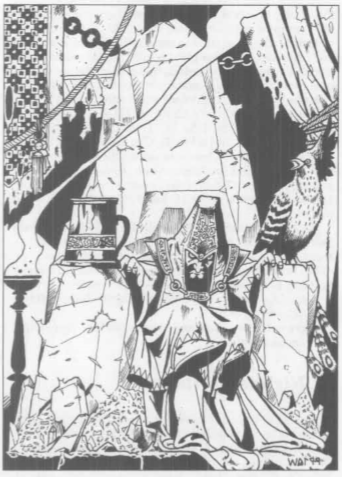
c.-1500 CY The Ur-Flan wizard-priest Keraptis came to the Golden City of Tostenhca, and unknown to the People, he unleashed a horde of aberrations and monstrosities upon its populace; and then announcing himself to them, he told them that he alone could rid them of the hordes. They were skeptical. They already had an abundance of heroes, and great and accomplished magi, and a temple of divine power that had kept them from harm until then. But had they, Keraptis asked, were they not beset by monsters; had their heroes and magi and priests protected them from the beasts that plagued them still? They had not, said the people of Tostenhca. So, the people agreed that if Keraptis could rid them of the ravaging hordes, they would make him Protector of Tostenhca and lavish him with gold. And he did, with a wave of his hand. Tostenhca paid him his gold. They made him their Protector.
But what of the Elves? How did they fare after their disastrous 600-year stalemate with Vecna? They persevered.
After the Gray Elves last city in the Crystalmists fell, the remnants fled eastward. They, in conjunction with their High Elven and Sylvan kindred, developed the four Elven Kingdoms. The Westernmost of these, the “Realm” of Highfolk in the Yatils and the Vesve was established as a guardian against the Seul and the Drow. This realm was established with the Sylvan elves of the Vesve. Of all the Elven realms, it was the most open to other races, allowing humans, gnomes, halflings and even dwarves to partake of its society. The second Kingdom, Celene, the [High Elven] “heart jewel” of Elvendom, [took in those Gray Elves who fled to their realm]. It, alone of the realms, is always ruled by an elven queen. The third Kingdom, Aliador, was established in the Griff Mountains and the plains to the west to the shores of the Nyr Dyv, it is also called the “Lost Kingdom.” This was the Crown of the Elven seat, and was inhabited solely by Gray Elves and their servants. The High King of All Elves had his place here. The Fourth Realm, Arrisa, was established by a council of mages and priests in the southern islands now known as the Spendrifts. It is called “The Secret Realm” and it has been closed for long. Little traffic passes between this realm and the remainder of the Flanaess. And its purpose, until recently, has been hidden (even to the other elven Realms). [OJ1]
Keraptis waxed and waned in the Northeast, as did Tzunk in the North.
Legend has it that The Isles or Woe once stood in the Nyr Dyv, but no one can pinpoint their location, their size, or even their number (some say three, some say seven). Who can say? No one has seen them in nigh a thousand years, though some have sought them out. Ancient maps hidden away in a secret room in the Great Library of Greyhawk show their location as southwest of the Scragholme Island upon a much smaller Nyr Dyv, rising from its wasters as though an extension of the Cairn Hills.
All sources say they were ancient, and they must have been, because they were gone when the People of Aerdy arrived. All sources say that they were highly magical. It is written that Tzunk wrote (or perhaps discovered, as the massive book has also been named Yagrax’s Tome) The Codex of the Infinite Planes there, and Tzunk is said to have been a lieutenant of Vecna’s. Even Vecna is said to have built his Black Tower upon one of the Islands, and that he ruled his vast Empire from his “rotted tower” and “spidered throne” there. Maybe he did; that ancient map indicates a small tower ore lighthouse on one, an open eye with a cat-like pupil placed upon a spindled base.
But the Wizard Priest Tzunk left no records. Only speculations follow his exploits, dim recollections of his ruling in Vecna’s absence, and of his raising an army to march against the City of Brass. But he was no match for an army of four million efreet. He was bested and brought to the efreeti sultan in chains, his body was cut into a hundred parts, the portions scattered to the winds, burned in fire, dissolved in acidic waters, and buried below the earth. And yet the power of the Codex would not let him die. Rumour has it that there is said to be a tomb holding Tzunk’s hands. Constructs with arcane powers guard it, and the tomb itself is filled with magical and mundane traps, secret portals, passages, and mazes. Legends say the hands will animate themselves if uncovered from their burial place and serve their rescuer as divinatory tools but slowly dominating their user in order to seek out the other parts of Tzunk’s indestructible, scattered body.
Mo matter. Those are but rumours and legends, even if the Archmage Marinian of Willip has set out into the Barrens for Blackmoor with evidence of the site of their burial, despite the dire warning that a Sisterhood of Ur-Flan Witches guards it from any who might seek it. But that is another tale.
What is known is that the Isles are no more, or not upon the surface of the Lake of Unknown Depth, at any rate. The Rhenne have a tale that says that the Elemental Kings took their revenge upon the Isles of Woe, rending the earth with tremor and storm and fire, and that the waters rose as though the world might be taken whole by them, drowning those fell wizard-priests as the price for Tzunk’s ambitions, and as a warning to any who might try their hand against them again. The Rhenne swear that those dire isles rise when Solune and Celene are both new, swallowing up any who might land there. But the Rhenne say a lot of things, and are notorious liars.
But in time, the Flan gathered themselves up after the tyranny of the Ur-Flan.
After this several small Flanae kingdoms arise, but none match the might of the Ur-Flanae under Vecna, several northern Flan fearing the both the wrath of the elves and the brutality of another lich-king flee their cities and turn back to tribal systems of government. One exception to this general dissolution is the area under an able Theign named Tenh. He manages to keep his people from scattering, although incursions by roaming monsters and undead into this area are frequent. [OJ1]

[Historical Development of Keraptis: Erik Mona, Lisa Stevens, Steve Wilson]
c.-800 CY Keraptis, ever scheming for more power, ranging far and wide in search of secrets, discovered the lava tubes beneath White Plume Mountain.
Three hundred years after leaving Tostenhca, Keraptis learned of a great volcano called White Plume Mountain, in which still-living druids of the Elder Age guarded the secrets of immortality. Within the volcano, the wizard found a tangled maze of lava tunnels and an ancient druid serving as the sole protector of Elder secrets. The two fought a titanic battle for ownership of White Plume Mountain and its ancient mysteries, but in the end the wizard prevailed. After casting the druid’s remains into a sea of magma, the triumphant Keraptis penetrated to the Druid’s Fane, a secret chamber protected by molten rock.
There, among other treasures of ancient sorcery, he found the archetypal iceblade Frostrazor and an enigmatic statuette. Keraptis used the figurine’s power to pronounce a heinous curse that laid waste to distant Tostenhca, thus exacting his revenge at last. Thereafter, Keraptis focused all of his vast faculties on the problem of death. He embarked on a dozen separate research efforts, all aimed at achieving eternal life without the need for constant magical maintenance and healing. It was one such project, empowered by the four enchanted implements he had obtained, that eventually allowed Keraptis to step forth from the Prime Material Plane into a distant shadowy realm where, he hoped, he would leave behind the constraints of mortality forever. [Return to White Plume Mountain] 1351_FT
[Historical Development of Keraptis: Erik Mona, Lisa Stevens, Steve Wilson]
-600 CY History of the Pyronomicon
We must pause to now consider what was happening in the East, as events there would draw the Peoples there back into the narrative of the Flanaess.
One must always give credit where credit is due. This History is made possible primarily by the Imaginings of Gary Gygax and his Old Guard. I cannot at this time give credit to all those others who’d contributed to it over the years, because I myself am still learning it and who wrote it. But I can give thanks to Steven Wilson for his GREYCHRONDEX and to Keith Horsfield for his “Chronological History of Eastern Oerik.”
Special thanks to Βικτώρια Κανελλοπούλου (Maria Viktoria Kanellopoulou) for allowing her most excellent artwork to grace this work. See ladyloth for more.
Copyright:
All source material presented within this chronology is owned and copyrighted by WotC.
The use of this material is not intended to challenge the rights of WotC.
This document is fan content and presented solely for the personal use of those individuals who game within the Greyhawk Setting.
Sources:
1015 World of Greyhawk Boxed Set, 1983
2011A Dungeon Masters Guide, 1st Ed., 1977
2023 Greyhawk Adventures Hardback, 1988
9027 S2, White Plume Mountain, 1979
9309 WGA4, Vecna Lives, 1990
9399 WGR 5, Iuz the Evil, 1993
9577 The Adventure Begins, 1998 AM=Adventure Maps Book
9578 Player’s Guide to Greyhawk, 1998
Dragon 241, November, 1997
OJ Oerth Journal, produced by the Council of Greyhawk, and appearing on their website
Aqua, Aquaria; unpublished
Greychrondex, Wilson, Steven B.
TSR11348 Return to White Plume Mountain, 1999

Content originally found on the Greyhawk Musings blog, by David Leonard.


Leave A Comment
You must be logged in to post a comment.